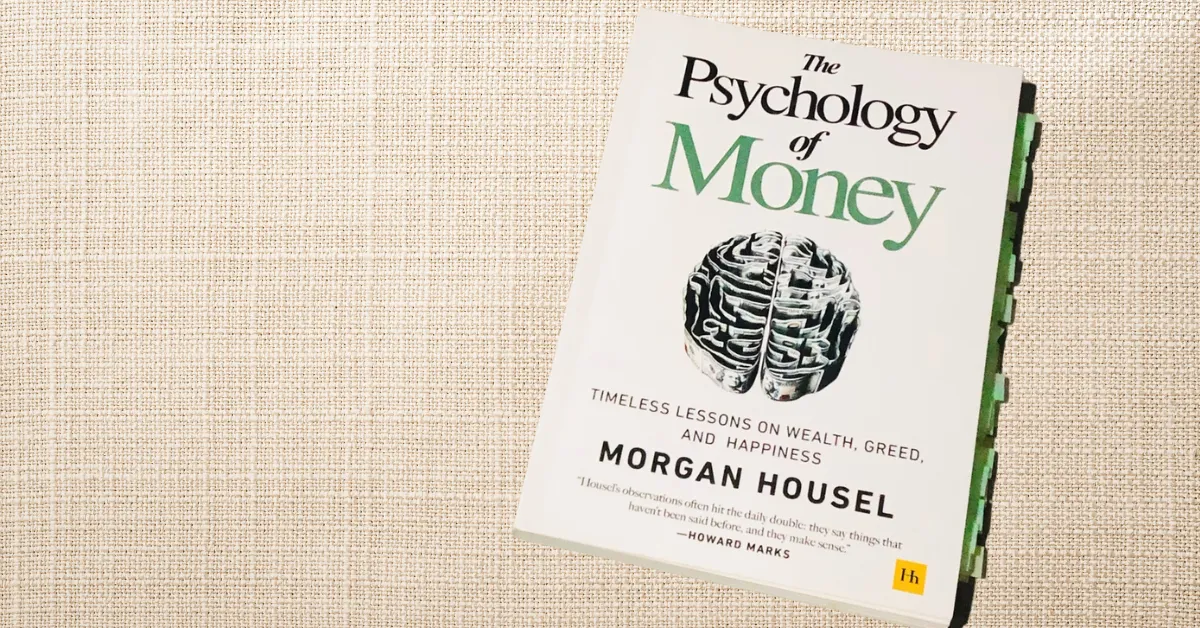
The Psychology of Money - Timeless Lesson on Wealth, Greed and Happiness
I bought The Psychology of Money by Morgan Housel thinking I knew what I was getting into.
Money mindset.
Personal finance.
Maybe a few lessons about building wealth.
What I didn't expect was a book that would make me question something much bigger.
How do I actually think about money?
Because yes, this book talks about investing.
But it's not really an investing manual.
Morgan Housel isn't here to tell you which stock to buy, where to put your money, or give you some magical formula for getting rich.
Instead, he spends the book exploring something much more interesting...
Why do people behave so differently with money in the first place?
And honestly, that was what kept me reading.
I was initially thinking, Okay... I'm not exactly an investing expert. Is this really my book?
But I stuck with it.
Because there's always something to learn.
And I'm glad I did.
Money is not just math.
This was probably one of my biggest takeaways.
We like to think money is logical.
You earn.
You save.
You invest.
You calculate.
You get the result.
Except... humans don't work like spreadsheets.
Housel explains that our financial decisions are shaped by our personal history, experiences, emotions, ego, fear, ambition, and the environment we grew up in.
Two people can look at the exact same financial decision and make completely different choices because they've lived completely different lives.
And suddenly, the title made sense.
It's not just about the money.
It's about the psychology behind what we do with it.
That made me think about business too.
Because entrepreneurs do the exact same thing.
We make decisions based on our past.
A bad client can change how we price.
A failed launch can change how much risk we're willing to take.
One successful campaign can make us overconfident.
A difficult season can make us play too safe.
We're constantly bringing our history into our decisions without realizing it.
Money just makes that behavior easier to see.
Wealth is what you don't see.
This was one of the ideas that really stayed with me.
We tend to think someone is wealthy because of what we can see.
The car.
The house.
The clothes.
The vacations.
The lifestyle.
But Housel flips that idea completely.
Wealth is the money you don't spend.
It's the savings sitting quietly in the bank.
It's the investments nobody sees.
It's the financial cushion that gives you options.
It's the ability to say no because you don't desperately need the money.
That's a very different definition of wealth.
And honestly?
I like that definition much more.
Because as I've gotten older, my idea of success has changed.
I don't just want more money so I can buy more things.
I want more freedom.
More choices.
More control over my time.
More ability to build the businesses I want.
More ability to spend time with the people I love.
That is the kind of wealth that actually matters to me.
Housel connects money with control over your time and choices, which he presents as one of money's most valuable benefits.
Less ego. More wealth.
This was probably my favorite mindset shift.
Wealth requires you to resist the urge to look wealthy.
And that takes a little humility.
Because let's be honest...
Sometimes we don't want money because we want financial security.
We want money because we want what money signals.
Status.
Success.
Proof.
Recognition.
We want people to look at us and think, She's doing well.
But the more I thought about it, the more I realized:
If I spend everything trying to look successful, I'm leaving less behind to actually build something.
That applies to business too.
You can look busy without building anything.
You can look successful without being profitable.
You can have a beautiful brand without having a healthy business behind it.
You can have thousands of followers without having real freedom.
The appearance of success and the substance of success are two very different things.
And it matters a lot.
The long game wins.
Another major lesson from Housel is the power of compounding.
But what I appreciated most wasn't simply the financial concept.
It was the reminder that time matters more than we often realize.
Small decisions repeated for a long time can create outcomes that look almost impossible when you only look at the final result.
That made me think about everything I'm building.
My businesses.
My personal brand.
My writing.
My content.
Even the small habits I have around learning and personal growth.
Most progress is boring while it's happening.
You don't wake up one morning and suddenly realize you've become a completely different person.
You read another book.
You write another post.
You make another good decision.
You learn from another mistake.
You keep going.
And then one day you look back and realize...
Oh. I've actually come a long way.
That's compounding too.
Reasonable beats perfect.
This was another lesson I really appreciated.
Housel makes the distinction between being rational and being reasonable.
A mathematically perfect financial strategy might look fantastic on paper.
But if the person following it can't emotionally stick with it when things get ugly... What's the point?
A reasonable strategy that you can actually live with may be better than a theoretically perfect strategy you abandon when life gets uncomfortable.
And honestly?
That applies far beyond investing.
Business strategy.
Productivity.
Health.
Personal goals.
Life.
We love perfect plans.
But life doesn't care about our plans.
Things happen.
Clients leave.
Projects fail.
Markets change.
People change.
We change.
Which brings me to another idea from the book that I loved.
Leave room for error.
Don't build a life or business that only works if everything goes perfectly.
Because it won't.
Something will go wrong.
That's not pessimism.
That's preparation.
And I think that's actually a very Stoic way of looking at life.
You don't control what happens.
You control how prepared you are to respond when it does.
Luck and risk deserve more respect.
One of the more humbling ideas in the book is Housel's discussion of luck and risk.
We love simple stories.
She worked hard, so she succeeded.
He made bad decisions, so he failed.
But reality is rarely that clean.
Luck can influence positive outcomes.
Risk can hurt someone who made reasonable decisions.
And sometimes the difference between two people's outcomes includes circumstances neither person completely controlled.
That doesn't mean effort doesn't matter.
It means we should be careful about turning someone else's success into a formula.
Or someone else's failure into a character judgment.
That one really resonated with me as a business owner.
Because I've had things work that I couldn't have perfectly predicted.
I've also had things fail despite doing what I thought was the right thing.
That's business.
That's life.
And maybe the lesson isn't to eliminate uncertainty.
Maybe it's to build something resilient enough to survive it.
And then there is "enough."
This might be the hardest lesson of all.
How much is enough?
Because if you don't define enough for yourself, there is always someone with more.
More money.
More clients.
More followers.
More businesses.
More houses.
More recognition.
More everything.
And suddenly you're spending your life chasing a finish line that keeps moving.
I think about this a lot as an entrepreneur.
There will always be another goal.
Another revenue milestone.
Another business idea.
Another level to reach.
Ambition is not the problem.
But ambition without a definition of "enough" can turn into an endless treadmill.
I don't want that.
I want to build.
I want to grow.
I want to make an impact.
But I also want to actually live.
Because what's the point of building a life you never have time to enjoy?
The quote I kept coming back to
One of the ideas from the book that stayed with me is..
"We all think we know how the world works. But we've all only experienced a tiny sliver of it."
That is such a humbling thought.
Especially for someone like me who works in marketing.
I can study consumer behavior.
I can understand branding.
I can analyze data.
I can build strategies.
But I still only see one small piece of a much bigger world.
And that means I need to stay curious.
Stay adaptable.
Stay humble enough to say:
"I might be wrong."
That mindset isn't weakness.
I think it's one of the most useful things a business owner can have.
Because the world changes.
Markets change.
People change.
We change.
And the smartest plan in the world is still going to meet reality eventually.
So what did this book actually change for me?
I started this book thinking I was going to learn more about money and investing. Instead, I walked away thinking more about freedom, patience, ego, uncertainty, and what kind of life I'm actually trying to build.
It reminded me that wealth isn't about proving something.
It's about having options.
It's about creating breathing room.
It's about being able to make decisions based on what matters instead of what you desperately need.
And maybe that's why this book stuck with me.
Because the older I get, the less interested I am in looking successful...
and the more interested I am in building a life that actually feels successful to me.
That means building businesses I believe in.
Creating work that matters.
Taking care of the people I love.
Learning.
Investing in myself.
And, yes, learning how to make my money work harder too.
But without losing sight of the bigger picture.
Because money is a tool.
It should give you more life.
Not consume the life you're trying to build.
And maybe that's the question I'm taking away from this book..
What are you actually trying to become wealthy enough to do?
Because once you know that...
the number might not be the most important part anymore.
