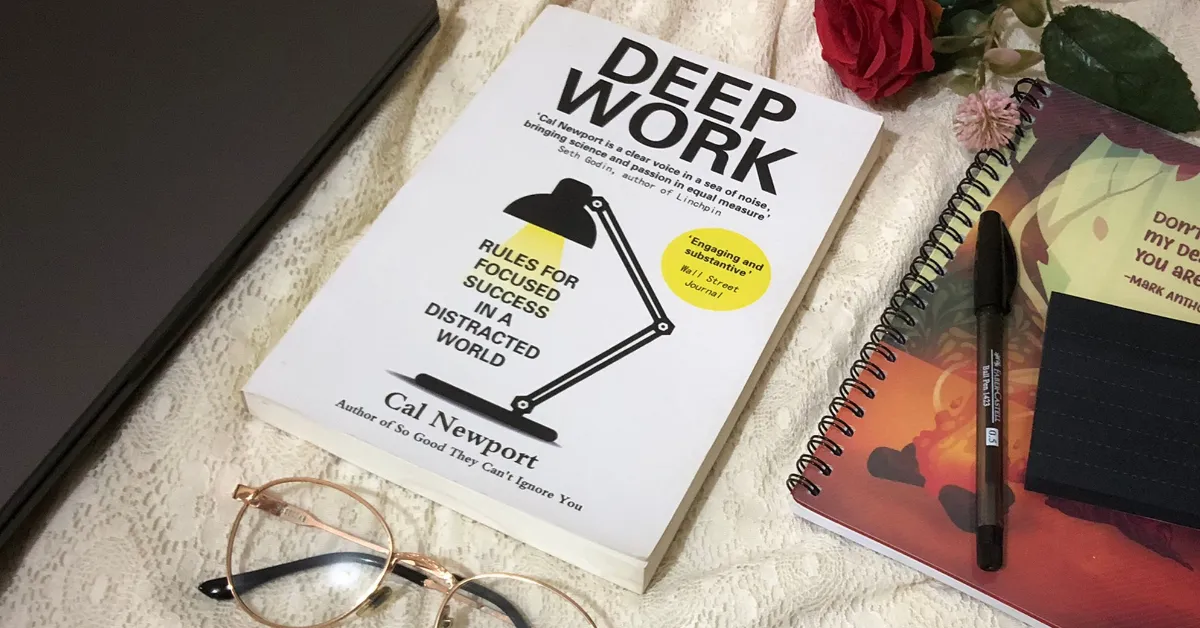
Deep Work - Rules For Focused Success In A Distracted World
I used to think my problem was too much to do. It was not.
My real problem was, I was letting my focus get pulled in too many directions.
I realized that I did not need another productivity book that told me to manage my time better. I needed a book that called out the real issue.. Deep Work did that.
This was one of the first books I bought when I made the decision to get serious about personal development and growth. And up until now it still shapes how I think about focus, work, and the way I build my life.
Reading this, the impact was immediate. It changed how I thought about work, attention, and the cost of constantly being available. Newport defines deep work as focused, distraction-free concentration on highly demanding tasks, and he argues that this kind of work is becoming both more valuable and more rare.
And that hit me sooo hard.
Because as a founder, and a digital marketer who’s constantly online, and someone juggling a lot of moving parts, I know how easy it is to confuse motion with progress.
Emails. DMs. Notifications. Tweaks. Checking. Re-checking. Responding. Planning. Replanning.
It can all look productive from the outside while quietly eating your ability to do the work that actually moves your business forward. Newport’s whole point is that deep work creates new value, improves skill, and is hard to replicate, while shallow work tends to be logistical, distracted, and easy to copy.
And honestly? That is a problem a lot of us do not want to admit.
What I appreciated about this book is that it does not just tell you to focus more. It gives you a framework for protecting your attention. Newport breaks the book into two big parts.
First, he makes the case that deep work is valuable, rare, and meaningful.
Then he gives practical strategies for building it into a busy life.
He also lays out four rules for doing that.
Work Deeply, Embrace Boredom, Quit Social Media, and Drain the Shallows.
That is where this book started to change my work.
Not because I suddenly became some perfect deep-work monk.
Please. I am still human.
But because it made me see that my attention is not free.
Every time I let shallow work take over, I am paying with time, clarity, and creative energy. And as a business owner, that, has real consequences. The more distracted I am, the harder it is to build something solid. The more divided my attention becomes, the more my business starts to feel scattered too.
After reading this book, I also became much more intentional about social media. Professionally, I still use it for marketing, but I changed how I spend time on it, how I manage my feed, how I filter information I take in and how quickly I let it pull me out of focus.
That is why this book mattered to me beyond business.
It reminded me that deep work is not just about getting more done. Newport says it can also create a sense of meaning and fulfillment, because doing hard, focused work feels better than spending the day in frantic busywork.
And that part hit deeply.
Because I do not just want a productive life.
I want a meaningful one.
And for me, that means learning how to protect my focus the way I protect my energy.
The part that really made this book stick for me was the framework.
Cal Newport does not just say focus more and leave you there. He gives you a way to actually build deep work into real life, which is what makes this book so useful.
He breaks it down into 4 rules:
1. Work Deeply
This is the obvious one, but also the hardest one to protect. It means creating time for real, uninterrupted focus on work that actually matters. Not half-working. Not multitasking. Not bouncing between tabs and tasks. Just deep work.
For me, this means protecting the parts of my day when I need to think, create, plan, or write. If I do not guard that time, it gets eaten by everything else.
I now have a specific time of the day where I do deep work. And thanks to the book Eat That Frog by Brian Tracy. Because the only thing I do in my deep work hours is dealing with the frog.
2. Embrace Boredom
This one hit me because most of us are not used to being still with our thoughts anymore. We reach for our phones the second things feel quiet. But Newport makes the point that if you cannot tolerate boredom, you train your brain to crave constant stimulation.
In my life, this showed up in how often I reached for social media or distractions without even thinking. So now I try to be more intentional with those in-between moments instead of letting my attention get pulled everywhere.
These days, my phone stays on Do Not Disturb all day, every day. Deep work or not, I do not want constant notifications stealing my attention. It gives me back the power to decide where my focus goes.
3. Quit Social Media
I did not read this as “delete every app and disappear off the internet.” That is not realistic for me as a marketer.
What I took from it was the reminder to be more intentional about how I use social media, how I manage my feed, and how much mental space I let it take up. I still use it for business, of course, but I am much more aware now of how quickly it can turn into noise if I let it.
I did not quit social media. But I do time-block the hours I spend on it. I turned off all social media notifications. I do not want to get pulled out of deep work just because my phone says Ana liked my photo on Instagram and ruins my writing mode.
I also became more mindful about the people I follow and connect with on these platforms. I want to be around people on a similar journey, people I can learn from, and people who can learn from the journey I am on too.
I no longer use social media just to entertain myself. I use it to learn, connect, and make impact.
4. Drain the Shallows
This means reducing the time and energy you give to low-value, shallow work. The little tasks that feel urgent but do not really move anything forward.
Emails. Random replies. Constant checking. Rechecking. Toggling between a hundred tiny things.
This one matters to me because shallow work is sneaky. It can make you feel productive while quietly draining your best energy. So I try to be more ruthless now about what deserves my attention and what does not.
And if you have worked with me, you probably already know I am a little hard to reach sometimes. I do not respond to texts on weekends and mornings. I time blocked everything. I have a fixed schedule productivity.
I have a fixed hours where I answer email, WhatsApp messages, when I write my content, even when I pee. Kidding!
The point is, design your schedule with the goal of reducing shallow work and prioritizing blocks of deep work and the most important tasks only.
That is what made Deep Work different for me. It was not just about productivity. It was about learning how to protect my attention like it actually matters, because it does.
For founders and builders, shallow tasks can pile up so easily that you end up doing nothing truly well. That is exactly the trap this book helps expose. This book definitely changed how I work, but also how I think about living.
I believe this book is not just for productivity or business growth.
It is for writing, building, planning, healing, creating, and thinking clearly enough to make good decisions. It is for the person trying to build something real without losing himself in the noise.
Cal Newport has a way of saying the thing most of us know but keep avoiding.
If you want better work, better output, and better results, you have got to stop giving your best hours to shallow distractions.
So yes, Deep Work made a lasting impact on me.
It taught me that focus is not a luxury.
It is a boundary.
It is a discipline.
It is a form of self-respect.
The hardest part of building anything meaningful is not always the work itself.
It is protecting the mental space to do the work well.
And maybe that is the question this book leaves us with..
What could your life and business look like if you stopped treating your attention like it’s always available?
